
How the Green Globe Certification Scoring System Works in Practice
🧾 Takeaways — Green Globe Certification at a Glance
Wondering how to Green Globe certification scoring system works, and how to get Green Globe certified? If you’re considering this certification for your hotel, here’s what you need to know upfront:
- 🧩 The Green Globe Standard includes 385 performance indicators, dispatched into 44 criteria, covering all aspects of sustainable hotel management.
- 🧿 Among the 385 performance indicators of the Green Globe Certification, 100 are mandatory, and 285 are so called non-mandatory.
- ✅ You must comply with 100 mandatory indicators.
- ➕ In addition, you must meet at least 50% of the non-mandatory indicators in each criteria.
- 📊 Categories include water and energy management, fair employment, local economic integration, procurement, biodiversity, and waste.
- 🧠 It’s one of the most detailed and rigorous sustainability certifications in hospitality.
Now, let’s explore it all in more detail. 👇
How to Get Green Globe Certified in Video
📚 Table of Contents
- 🧾 Takeaways — Green Globe Certification at a Glance
- 🌿 What Is Green Globe Certification?
- 🧩 What Are the Green Globe Criteria?
- 🧠 How Does the Scoring System Work?
- 📊 An Example of Green Globe Certification Requirements
- 🔍Green Globe Certification Scoring – Practical Audit Questions & Real-World Scoring Issues
- 🌍 Why Become a Green Globe Certified Hotel?
- 📋 What Is the Green Globe Program Process?
- 📌 Summary: How to Get Green Globe Certified
- ❓ FAQ – Green Globe Hotel Certification
🌿 What Is Green Globe Certification?
Green Globe is a sustainability certification program launched in 1993. It’s focused primarily on the hospitality and tourism industry, and it is widely recognized across the globe. From energy and water use to social responsibility and local economic impact, Green Globe covers it all.
Whether you’re running a boutique hotel in Bali or a luxury resort in the Caribbean, getting Green Globe certified signals to your guests that you take sustainability seriously. This certification actually acknowledge and officially recognize the hospitality sustainability best practices that the establishment implemented.
🧩 What Are the Green Globe Criteria?
There are 44 core criteria in the Green Globe Standard. Within these criteria, you’ll find:
- 100 mandatory indicators
- 285 non-mandatory indicators
These indicators cover every angle of sustainable hotel management:
- 🌊 Water conservation
- ⚡ Energy efficiency
- 🗑️ Waste management
- 🤝 Fair employment practices
- 🛒 Responsible procurement
- 🌱 Biodiversity protection
- 🏘️ Community involvement
This makes Green Globe one of the most comprehensive hotel certification programs available, and a key actor of sustainable tourism certification. This type of pioneer labels definitely helped to define what is ecotourism.
🧠 How Does Green Globe Scoring System Work?
Now let’s get into the core of it: the Green Globe scoring system.
To become certified:
✅ You must comply with all 100 mandatory indicators.
✅ You must also meet at least 50% of the non-mandatory indicators in each of the 44 categories.
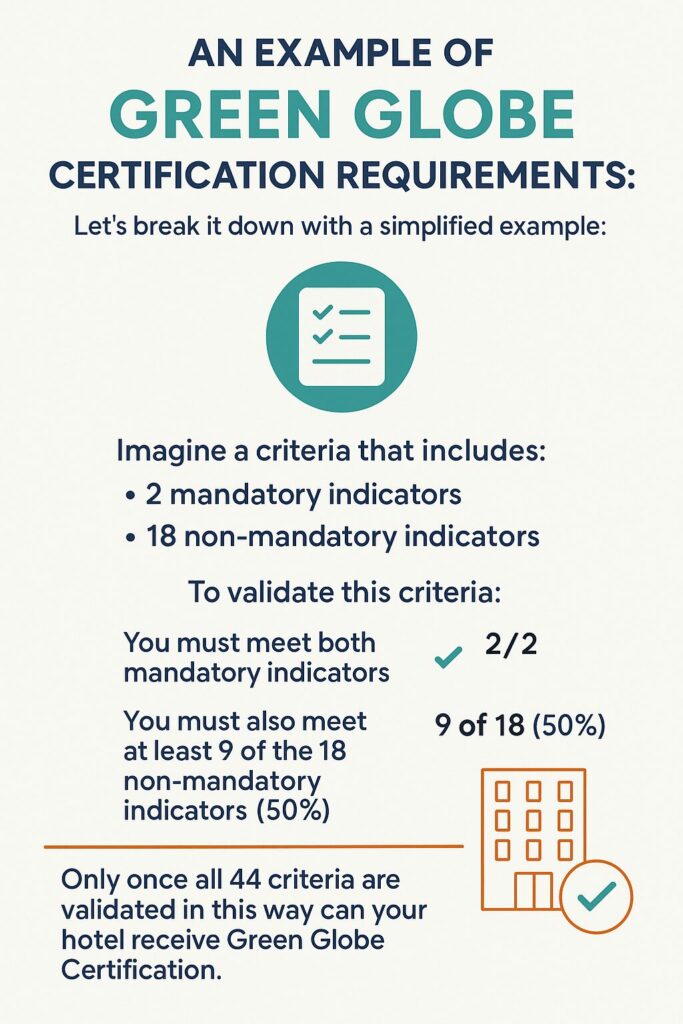
📊 An Example of Green Globe Certification Scoring Calculation
Let’s break it down with a simplified example:
Imagine a criteria that includes:
- 2 mandatory indicators
- 18 non-mandatory indicators
To validate this criteria:
- You must meet both mandatory indicators (2/2 ✅)
- You must also meet at least 9 of the 18 non-mandatory indicators (50%)
Only once all 44 criteria are validated in this way can your hotel receive Green Globe Certification. 🏨✅
Q / A Green Globe Certification Scoring – Practical Audit Questions & Real-World Scoring Issues
Can a hotel pass without complying with mandatory indicators?
No.
By definition, mandatory indicators are non-negotiable within the Green Globe certification system.
In practice, a hotel may achieve a relatively strong overall score, but any significant weakness in mandatory sections can lead to certification failure, regardless of performance elsewhere. These indicators are treated as minimum compliance requirements, not as compensable criteria.
As a result, hotels must prioritize mandatory indicators early in the process. Insufficient performance on these points cannot be offset by higher scores in optional or weighted criteria, and is one of the most common reasons for unsuccessful first audits.
How are partially compliant criteria scored during the audit?
In practice, partially compliant indicators are often treated with a short correction window rather than an immediate failure.
Following the on-site audit, hotels are typically given a limited timeframe — often a few days — to implement minor corrective actions and provide additional evidence. This applies mainly to indicators that are considered borderline or “in balance”, where compliance can be reasonably achieved without structural changes.
However, this tolerance remains strictly limited. If the required improvements are not implemented within the agreed timeframe, the criteria is usually scored as non-compliant. Partial compliance should therefore be seen as a temporary opportunity to adjust, not as an accepted final state.
What Green Globe criteria are most frequently misunderstood by hotels?
Based on practical audit experience, several Green Globe criteria are consistently misunderstood or underestimated by hotels.
First, criteria related to cultural and natural experiences offered to guests often create confusion. Hotels tend to focus on availability rather than on how these experiences are structured, promoted, and aligned with local heritage and biodiversity requirements.
Second, documentation-related criteria are a frequent weak point. The Yearly Action Plan and the Annual Sustainability Report are often incomplete, with key information missing, insufficiently detailed, or not clearly linked to measurable objectives and results.
Finally, Environmental Impact Assessment (EIA)–related criteria are commonly misinterpreted. Many hotels underestimate the level of analysis expected when assessing the environmental impacts of their operations on the surrounding area, including local ecosystems, water resources, and community interactions.
Which criteria usually generate non-conformities during the first audit?
In practice, non-conformities during a first Green Globe audit most often relate to areas that fall outside day-to-day hotel operations.
This includes criteria linked to relationships with local communities, external waste management and treatment, and the nature and quality of employee benefits provided beyond contractual obligations. These topics are frequently less formalized, less documented, or managed by external partners, which increases the risk of gaps during the audit.
For internal operations, the use, handling, and storage of chemical products is one of the most common sources of non-conformities. Inadequate procedures, missing safety documentation, or improper storage conditions are regularly identified during initial audits.
What types of evidence are most often rejected during the audit process?
During the audit process, evidence is most often rejected due to relevance, validity, or level of detail.
First, outdated documents are a common issue. Policies, procedures, or records that are no longer current or do not reflect present operations are typically not accepted.
Second, auditors frequently reject generic certificates provided by suppliers that do not specifically correspond to the exact products or services used by the hotel. General corporate certificates or broad sustainability statements are not considered sufficient proof of compliance.
Finally, official documents that address indicators too vaguely are often challenged. When key requirements are mentioned only superficially, without measurable actions, scope, or clear linkage to the indicator’s intent, the evidence is usually deemed insufficient.
How is the final score affected if some criteria are marked “not applicable”?
When a criterion is legitimately marked as “not applicable,” it is simply removed from the list of indicators to be assessed.
As a result, it does not enter into the audit score calculation at all. The hotel is neither penalized nor advantaged by the exclusion of a non-applicable criterion, as the final score is calculated only on the basis of the remaining relevant indicators.
This mechanism ensures that the audit score accurately reflects the hotel’s operational reality, rather than forcing compliance with criteria that do not apply to its context or activities.
Can a pre-audit realistically estimate the final Green Globe score?
Yes — when conducted properly, a pre-audit can provide a highly reliable estimate of the final Green Globe score.
Unlike audits such as HACCP or financial audits, a Green Globe audit is cross-departmental and multi-disciplinary. It covers operational practices, documentation, governance, environmental impacts, human resources, community engagement, and supplier management across the entire property. This complexity makes first-time certifications particularly exposed to gaps and misinterpretations.
For an initial certification, a pre-audit is therefore a critical step. It allows hotels to verify that all required evidence is not only available, but also aligned with Green Globe’s actual audit expectations, rather than assumed compliance.
When a pre-audit is carried out by hospitality sustainability experts with direct Green Globe audit experience, it becomes a practical simulation of the real audit process. This significantly reduces uncertainty, limits the risk of non-conformities, and provides a realistic projection of the final score — well before the official audit takes place.
🌍 Why Become a Green Globe Certified Hotel?
Becoming a Green Globe hotel gives you more than just a label. The certification allows you to question your operations, especially when you create your hotel environmental policy. It also demonstrates to your guests:
- Verified commitment to sustainability 🌱
- Increased trust with eco-aware travelers 🧳
- Competitive advantage on booking platforms 🏆
- Better resource management (saves $!) 💧⚡
- Alignment with global climate goals 🌎
In fact, Green Globe certified hotels are often preferred by corporate clients and tour operators looking to reduce their Scope 3 emissions.
📋 What Is the Green Globe Program Process?
- Membership Application: Join the Green Globe program.
- Self-Assessment: Evaluate your property based on the Green Globe criteria.
- Implementation: Adjust your operations to meet mandatory and optional criteria.
- Audit: Undergo a third-party audit.
- Certification Issued: If successful, receive the label.
- Annual Monitoring: Maintain standards with annual reviews.
📌 Summary: How to Get Green Globe Certified
| Step | Requirement |
|---|---|
| 1️⃣ | Join the Green Globe program |
| 2️⃣ | Complete self-assessment |
| 3️⃣ | Meet 100% of mandatory indicators |
| 4️⃣ | Meet ≥50% of optional indicators in each category |
| 5️⃣ | Pass third-party audit |
| 6️⃣ | Maintain and improve performance annually |
Ready to get started? Join the growing list of Green Globe certified hotels today—and lead the way toward a more sustainable hospitality industry. 🌿
Want expert help preparing your self-assessment? Have a look at our hotel sustainability consultants offers or Contact us today!
❓ FAQ – How to Get Green Globe Certified?
What are the criteria for Green Globe certification?
There are 44 criteria with 100 mandatory indicators and 285 non-mandatory ones. You must meet all mandatory indicators and at least 50% of the optional ones per criteria.
How long does it take to become certified?
The process typically takes 3 to 6 months, depending on your readiness and internal changes needed.
How much does Green Globe certification cost?
Pricing depends on your hotel’s size, location, and number of sites. The yearly membership fee starts at USD 825 (for a 0 to 19 rooms hotel) and goes up to USD 5,500 (for a 250+ rooms hotel).On top of that comes a yearly audit cost of USD 1,600. More details here.
What makes Green Globe different from other ecolabels?
Its depth. The Green Globe Standard uses one of the most detailed scoring systems in the hospitality industry, with 385 performance indicators.
Is Green Globe recognized internationally?
Yes. The Green Globe program is widely respected and used across more than 80 countries. This label is at the forefront of hospitality sustainability certifications, such as EarthCheck or Green Key. Click here to get to know how to become Green Key certified.